
Iʿtikāf – An Act of Devotion
Iʿtikāf is a spiritual practice in Islam that involves secluding oneself for worship and reflection, traditionally in a mosque, with the aim of deepening one’s relationship with God. Although the Qur’an mentions iʿtikāf briefly, its significance is profound, as it embodies core Qur’anic themes of devotion, mindfulness, and withdrawal from distraction in order to focus entirely on remembrance of God. The practice reflects Islam’s emphasis on intentional worship and inner purification rather than ritual alone.
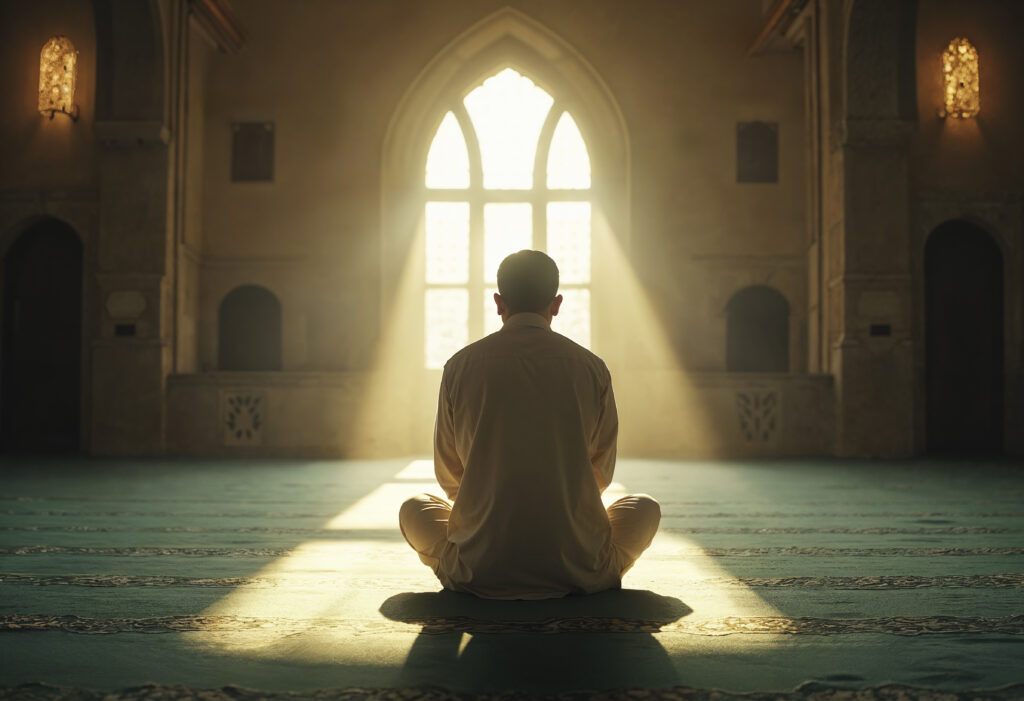
The Qur’an explicitly refers to iʿtikāf in the context of mosques and worship, stating: “Do not have relations with them while you are in retreat in the mosques” (Qur’an 2:187). This verse affirms the legitimacy and sanctity of iʿtikāf, indicating that it is a recognized form of worship requiring dedicated time and self-restraint. By setting clear boundaries during retreat, the Qur’an emphasizes that iʿtikāf is meant to create a space free from worldly concerns, allowing individuals to devote themselves fully to spiritual pursuits.
Another foundational reference appears in the account of Abraham and Ishmael: “Purify My House for those who perform ṭawāf, those who stand, and those who remain in retreat” (Qur’an 2:125). Here, those who remain in retreat are mentioned alongside other acts of worship, highlighting iʿtikāf as part of a long-standing tradition of devotion. This verse connects the practice to the sacred history of worship centered on the remembrance of God, reinforcing its spiritual legitimacy and continuity.
The importance of iʿtikāf lies in its purpose rather than its duration. The Qur’an repeatedly calls believers to remember God frequently and sincerely. “Remember your Lord within yourself, humbly and in awe, without loudness in words, in the mornings and evenings” (Qur’an 7:205). Iʿtikāf provides an environment ideally suited to fulfilling this command, offering uninterrupted time for prayer, reflection, and recitation of the Qur’an. By stepping away from daily routines, individuals can recalibrate their priorities and renew their spiritual focus.
Iʿtikāf is often associated with the month of Ramadhan, a time already marked by heightened devotion and reflection. The Qur’an describes Ramadhan as the month in which the Qur’an was revealed as guidance for humanity (Qur’an 2:185). Engaging in iʿtikāf during this period intensifies one’s engagement with that guidance, allowing deeper contemplation of its meanings and implications. The retreat becomes a practical response to the Qur’anic call to reflect upon its message rather than merely recite it.
Beyond individual benefit, iʿtikāf reinforces the Qur’anic value of sincerity in worship. Withdrawing from social interaction and material concerns removes opportunities for display or recognition, aligning worship solely with seeking God’s pleasure. The Qur’an emphasizes that deeds are known to God and that He is aware of what is hidden within hearts (Qur’an 2:77).
In conclusion, the Qur’an presents iʿtikāf as a meaningful act of devotion rooted in self-restraint, remembrance, and spiritual focus. Though mentioned briefly, its importance lies in how it embodies key Qur’anic principles: sincere worship, mindful withdrawal from distraction, and renewed commitment to divine guidance. Through iʿtikāf, believers create space for inner transformation and a deeper connection with God.
What could we improve?
Thanks! What would you like to read more about?
Thanks for your feedback!
You've already given feedback on this article — thank you!